


Tuesday, February 10, 2009

Saturday, February 7, 2009
Myasthenia Gravis and Local Anesthetics
I have come across a second patient now with MG that exhibited poor analgesia from local anesthetic. A middle-aged female with MG and Hep C underwent external levator repair yesterday. Pain control was poor despite generous amount of subcutaenous infiltration. Paralytic effect was also poor, as orbicular muscle contracted vigorously during unipolar incision. Extra amount of local anesthetic was required, resulting in eventual paralysis of the levator muscle and inablity to assess function of repair on the table. Patient was also exquisitely sensitive to stretching of the levator muscle, even though already immune from pain when muscle pinched by forceps. She is complicated by (1) her hepatic disease which may alter metabolism of lidocaine, and (2) a hyperacute personality which may be equating tactile sensation to pain.
A year ago I performed a cataract phacoemulsification of a 80 year of female with MG. A retrobulbar anesthesia was given due to unsteady eye position pre-op and squeezing of lids. Despite a good RBB, patient regained movement of eye shortly after beginning of case, making rest of procedure more challenging. The procedure was otherwise uncomplicated.
I wonder if MG somehow hinders the efficacy of local anesthetic. A brief PubMed search under "MG and local anesthetic", "MG and lidocaine", and "MG and analgesia" has not turned out report of similiar cases or mechanisms proposed. MG affects the neuromusclar junction via antibody against the nitoctinic ACH receptor. ACh receptor activation normally leads to dipolarization of the muscle cell, involving Voltage-gated Na channels. Lidocaine works by blocking this channels. Therefore one mechanisms of poor akinesia by lidocaine in MG may be a subsequent up-regulation of these Na channels due to chronic ACh receptor suppression. Literature search found only one paper on the subject, which reported DECREASE of Ach and Na channels at the endplate. Marx A, Siara J, Rüdel R Sodium and potassium channels in epithelial cells from thymus glands and thymomas of myasthenia gravis patients.
Association may be complicated as MG comes with other autoimmune conditions. Also, a second type of the MG has been identified that affects MuSK (muscle specific kinnase).
.
A year ago I performed a cataract phacoemulsification of a 80 year of female with MG. A retrobulbar anesthesia was given due to unsteady eye position pre-op and squeezing of lids. Despite a good RBB, patient regained movement of eye shortly after beginning of case, making rest of procedure more challenging. The procedure was otherwise uncomplicated.
I wonder if MG somehow hinders the efficacy of local anesthetic. A brief PubMed search under "MG and local anesthetic", "MG and lidocaine", and "MG and analgesia" has not turned out report of similiar cases or mechanisms proposed. MG affects the neuromusclar junction via antibody against the nitoctinic ACH receptor. ACh receptor activation normally leads to dipolarization of the muscle cell, involving Voltage-gated Na channels. Lidocaine works by blocking this channels. Therefore one mechanisms of poor akinesia by lidocaine in MG may be a subsequent up-regulation of these Na channels due to chronic ACh receptor suppression. Literature search found only one paper on the subject, which reported DECREASE of Ach and Na channels at the endplate. Marx A, Siara J, Rüdel R Sodium and potassium channels in epithelial cells from thymus glands and thymomas of myasthenia gravis patients.
Association may be complicated as MG comes with other autoimmune conditions. Also, a second type of the MG has been identified that affects MuSK (muscle specific kinnase).
.
Saturday, January 24, 2009
Gravitational Lensing, Gravitational "Streaking"?
An interesting phenomenon called "gravitation lensing" is caused by a massive object such as a star or a black hole, that intervenes between a distance light source and an observer. This is caused by the bending of light near the gravitational well. Unlike a classical lens which bends light the greatest at the periphery, the gravitation lens bends the light greatest at the center, and weakest at the periphery.

Thus, instead of a focal point, it has a focal line. And instead of a point image, it produces a ring of light, called the Einstein ring.


This phenomenon has been used to estimate the size of the intervening object, the "lens", which otherwise cannot be oberved due to lack of native luminance. Here is an animation of the effect of a beam of light moving behind a black hole.

As an ophthalmologist, one would immediately notice the "against" motion of the lens arc, ie, while the light is moving down and to the left, the arc moves in the opposite direction. Imagine the light streaking across comes from a retinoscope, and us the observers are sitting at the back to the retina, i.e. earth, we could conclude that the grativational lens is of plus-power.
While there is no giant hand streaking the distant light source back and forth, the angular motion of the source light relative the lens may be induced either by the motion of the earth, "parallex motion", or of the sun "proper motion". Therefore, it is reasonable to hypothesize that the speed by which the arc migrates may be related to the mass and the relative distances of the lens system. Currently the mass is already able to be calculated by the lens effect, and distance is estimated by red-shift. But this "gravitational streaking" may be useful in aiding their calculations.

Thus, instead of a focal point, it has a focal line. And instead of a point image, it produces a ring of light, called the Einstein ring.


This phenomenon has been used to estimate the size of the intervening object, the "lens", which otherwise cannot be oberved due to lack of native luminance. Here is an animation of the effect of a beam of light moving behind a black hole.
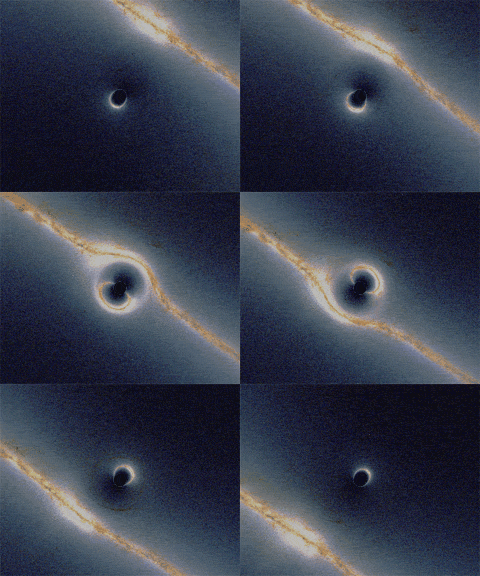
As an ophthalmologist, one would immediately notice the "against" motion of the lens arc, ie, while the light is moving down and to the left, the arc moves in the opposite direction. Imagine the light streaking across comes from a retinoscope, and us the observers are sitting at the back to the retina, i.e. earth, we could conclude that the grativational lens is of plus-power.
While there is no giant hand streaking the distant light source back and forth, the angular motion of the source light relative the lens may be induced either by the motion of the earth, "parallex motion", or of the sun "proper motion". Therefore, it is reasonable to hypothesize that the speed by which the arc migrates may be related to the mass and the relative distances of the lens system. Currently the mass is already able to be calculated by the lens effect, and distance is estimated by red-shift. But this "gravitational streaking" may be useful in aiding their calculations.
PET scan and Sexual Orientation
An article in the July 8th, 08's Proceeding of National Academy of Science boasted this grabbing title: "PET and MRI show differences in cerebral asymmetry and functional connectivity between homo- and heterosexual subjects"
Here's a telling image: Area activated is the amygdalae, the center for pheramon sensing and emotional learning. The study suggests heteralsexual men exhibit unilateral activation, while heteralsexual women exhibit bilateral activation, which is reverved in homosexual men and women.

Here's a telling image: Area activated is the amygdalae, the center for pheramon sensing and emotional learning. The study suggests heteralsexual men exhibit unilateral activation, while heteralsexual women exhibit bilateral activation, which is reverved in homosexual men and women.

Sunday, January 4, 2009
Jan 4th, Picture(s) of the Da
Ever wonders what c-ANCA and p-ANCA actually look like? Well, I never did either, but here they are.


Sunday, December 24, 2006
Re-operations in breast augmentation.

The December 06 supplemental of Plastics and Reconstructive Surgery devoted a large portion to the issue of re-operations in breast augmentation. A panel discussion by experts is rounded off with two illustrative articles of complications of these secondary surgeries: wound necrosis, lost nipples, that sort of thing. Now why is this suddenly an issue? A recent study has suggested that 15-20% in patients who have underwent breast augmentation had their breasts went under the knife a second time within 3 years. This could not have come at a worse time for this procedure, as the FDA is just about to lift the ban on silicon breast implants put in place since the 1990's.
Now let us put aside the safety issue of silicon implants, as the same statistics apply to both silicon and saline, and instead ask a seemly absurd question: Is this a big deal? How bad is it to have one in five of your patients come back to your office in one to three years, angrily opens her blouse and says "Doc you have to do something about this."?
Some would argue that the re-op rate is justified as the expectation of plastics surgery is much higher than in other surgical fields. They invoke the analogy of redecorating one's apartment, be it an appropriate analogy or not. When you pay premium, you want things to be just right. If it means returning to Home Depo ten times to get the right faucet to go with the curtain, so be it. The public's sentiment seems to echo this. They already know what's involved from the last go-around, and they extrapolate what will happen in the re-op from previous experiences, as humans naturally do. If things ended too low the first time around, we'll just get it higher this time. And if in another five years, it sags again. We'll go at it a third-time. No big deal.
So here we are, an eager, positive, solution oriented woman teaming up with a surgeon who's seen it all and fixed it all. Before you know it, we are wheeling into that OR for the sixth time. Just a little touch up. No big deal.
But as all surgeons know, the second time around is never the same as the first. And the third, fourth, and those that follow are anyone's guess. There is more scarring, more bleeding. One is more likely to get lost, as the anatomy has been distorted. Some the vessels have been divided in the first surgery, so the healing will be slower. An otherwise viable flap dies. Therefore we have complications. Therefore we enter the spiral.
Surgeons strive to get things right the first time around. We measure just one extra time before we cut. We replace that last suture because it "just didn't look right." I do not care how extra-ordinarily demanding the patients are, in any field, twenty percent re-op rate is a HUGE problem. It cannot be justified by the personalitiy profiles of the patients. Expect this to become more publicized in the press in 07. Patients will still come, though. But we must re-think our approach if we were to stem this man-made epidemic.
Subscribe to:
Posts (Atom)